 listicle
Best Heavy Machinery for Residential Landscaping Projects
Table of Contents
- Matching Machines to Residential Landscaping Projects
- The Best Skid Steer for Landscaping: Why It's the Residential Workhorse
- Mini Excavator for Landscaping: Digging, Trenching, and Tight Access
- Wheel Loaders, Backhoes, and Dozers: When Bigger Machines Make Sense
- Landscaping Equipment Rental vs. Buying: A Total Cost of Ownership View
- Fleet Management for Landscaping Businesses: Why It Beats Auction Cycles
- Conclusion
- Frequently Asked Questions
Last Updated: October 17, 2026
Matching Machines to Residential Landscaping Projects
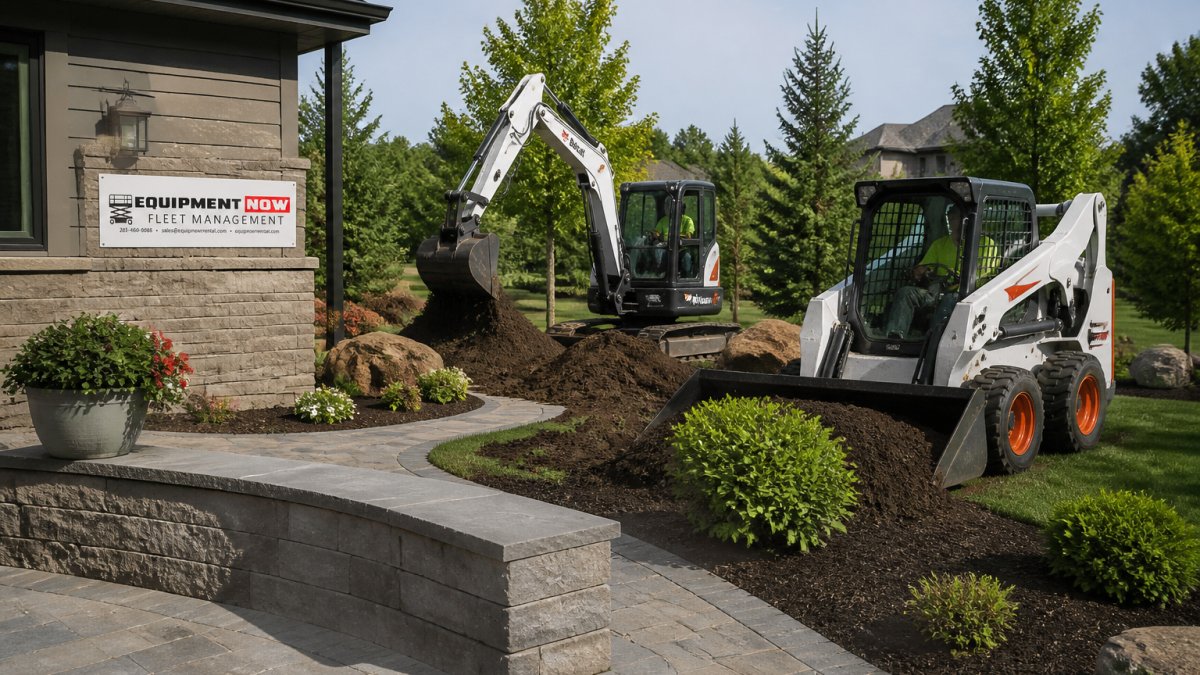
The best heavy machinery for residential landscaping projects is compact equipment sized to fit through a gate, turn in a driveway, and finish a job without tearing up the lawn next door. At Equipment Now Rental and Sales, we match machines to yard size, access width, and soil conditions before anything else, because the wrong machine costs more in repairs and lost time than the right one costs to rent.
Residential landscaping is a different discipline from commercial site work. You are rarely moving hundreds of cubic yards. You are shaping beds, cutting grades, trenching irrigation, clearing brush, and hauling soil through spaces a full-size machine cannot enter. That changes the entire calculus.
Below, we break down which machines handle which residential tasks, where bigger equipment earns its keep, and why owning a managed fleet beats chasing auction listings for a growing landscaping business.
The Best Skid Steer for Landscaping: Why It's the Residential Workhorse
The best skid steer for landscaping is a compact, highly maneuverable loader that runs dozens of attachments from a single platform. Its zero-tail-swing or tight-tail design lets it pivot inside a residential driveway, and a quick-attach coupler swaps a bucket for a tiller, auger, or mower in minutes.
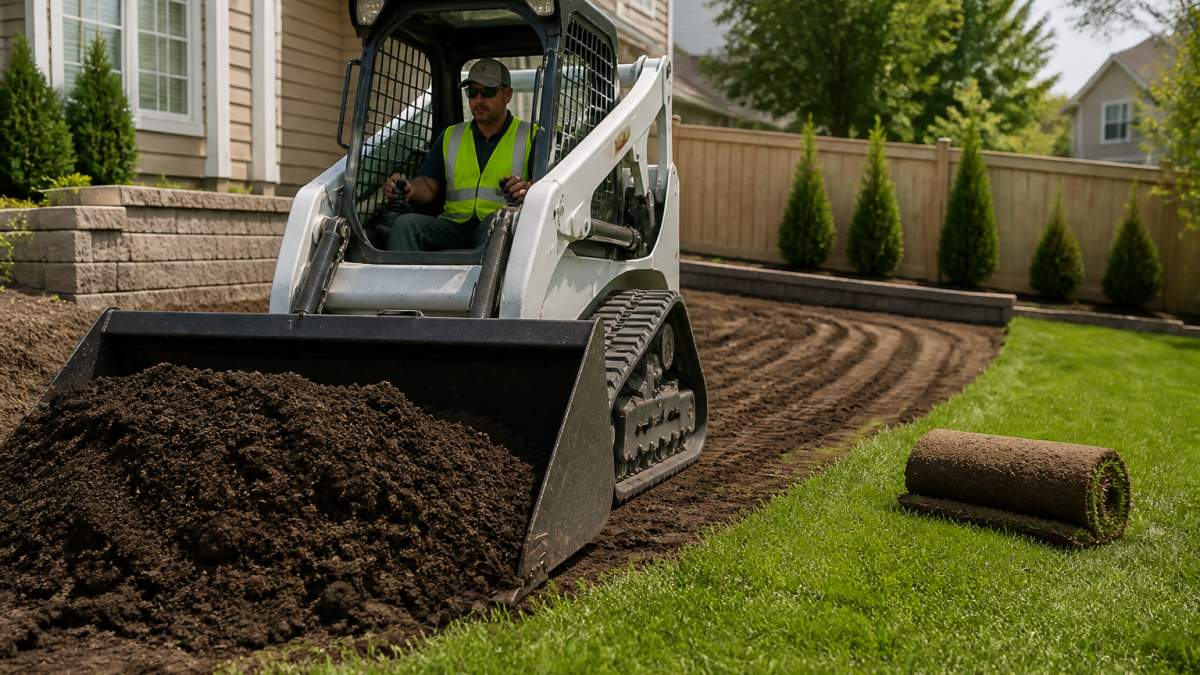
That attachment ecosystem is the real argument. One skid steer with the right implements replaces a tiller, a trencher, and a small dump trailer. For a landscaping crew working multiple residential projects a week, that versatility is hard to match.
The trade-off: skid steers turn on their own footprint, and that scrubbing action can scar turf. Plan turning points on gravel, pavement, or plywood mats.
Skid Steer vs. Compact Track Loader: Ground Pressure and Lawn Damage
A compact track loader spreads its weight across a longer, wider footprint than a skid steer, which lowers ground pressure and reduces rutting on soft or finished turf. The catch is cost, weight, and slower travel between jobs.
| Machine | Ground Contact | Turf Impact | Best Residential Use |
|---|---|---|---|
| Skid steer (wheeled) | Four tires, high contact pressure | High on soft ground | Hardscape, demo, gravel work |
| Compact track loader | Continuous tracks, low contact pressure | Low on established lawns | Finish grading, wet or sandy soil |
| Multi-terrain loader | Articulated tracks, very low pressure | Lowest of the three | Sensitive sites, steep or muddy ground |
If a project ends at a finished lawn, a compact track loader or multi-terrain loader is usually the safer call. For demolition and material handling on gravel, a wheeled skid steer is faster and cheaper to run.
Mini Excavator for Landscaping: Digging, Trenching, and Tight Access
A mini excavator for landscaping handles the digging work loaders cannot: trenching irrigation and drainage lines, excavating planting beds, removing stumps, and shaping grades in spaces a backhoe cannot reach. Compact frames let these machines pass through narrow side yards and work beside foundations.
The key specs to check are dig depth, reach, and tail swing. A zero-tail-swing mini excavator can dig against a fence line without clipping it. Attachments matter too: augers for post holes, breakers for rock, and thumbs for grabbing debris all extend the machine's range.
Where mini excavators fall short is hauling. They dig and stockpile; they do not move volume efficiently. Pair one with a skid steer or dump trailer and the workflow closes.
Wheel Loaders, Backhoes, and Dozers: When Bigger Machines Make Sense
Bigger machines earn their place when a residential project crosses into small commercial territory: a full lot regrade, a long driveway build, or land clearing across an acre or more.
- Backhoe loaders combine a loader bucket and a digging arm in one unit, useful for utility work and material handling on mid-size sites.
- Wheel loaders move soil and aggregate fast over distance, which matters on larger lots with stockpile-to-grade hauling.
- Dozers handle grading and land clearing at scale, but their weight and turning radius make them a poor fit for tight residential lots.
For most single-family projects, these machines are overkill. The exception is a site with real volume to move and the access to support it. Check machine dimensions and operating weight against gate widths and driveway load limits before committing.
Landscaping Equipment Rental vs. Buying: A Total Cost of Ownership View
Landscaping equipment rental wins for occasional-use machines, and buying wins when a machine runs most weeks of the season. Total cost of ownership settles the question: purchase price, financing, insurance, maintenance, storage, transport, and resale value all count against rental rates and delivery fees. But the decision is not just rent versus buy, it is also how you buy. Auction purchases often look like the cheapest path to ownership, but they push hidden costs into the future: unknown service history, missing maintenance records, no warranty, and resale value that depends on finding another buyer.
A practical framework starts with utilization. If a machine runs fewer than a few days a month, rental usually wins because you pay only for the time you use it and someone else handles maintenance, storage, and transport. If a machine runs most weeks of the season, ownership starts to make sense, but only if the machine is the right one and is maintained properly. That is where fleet management changes the math.
Consignment sales offer a middle path that auctions cannot match. When you buy through consignment, you typically get a machine with known history and an inspection, and you can ask questions about how it was used. When you sell through consignment, you set a realistic asking price and market to buyers who want that specific machine, instead of accepting whatever the auction brings on a given day. For a landscaping business that occasionally turns over equipment, consignment keeps more control on both sides of the transaction.
A common pattern is a mixed fleet: own the core machines that run most of the season, rent the specialty units that see occasional use, and use consignment or fleet management to handle acquisition and retirement. That structure avoids the two classic mistakes, buying too much machine at auction and letting it sit idle, or renting everything and losing the productivity that comes from having the right machine on hand when a project starts.
Pricing depends on the machine, rental period, and delivery distance, so ask for a full quote rather than comparing headline rates. Hidden delivery and fuel charges are the classic budget killer. The same discipline applies to ownership: a full cost picture includes insurance, storage, maintenance, and the eventual resale or retirement value, not just the purchase price. Fleet management makes that picture visible, and consignment makes the exit cleaner than an auction lot.
Fleet Management for Landscaping Businesses: Why It Beats Auction Cycles
Fleet management for landscaping businesses replaces the auction gamble with a planned asset lifecycle. Auctions look cheap up front, but the true cost shows up later: unknown service history, surprise repairs mid-season, no warranty, and resale value that depends on finding another buyer. For a residential landscaping crew, a mid-project breakdown does not just cost a repair bill, it costs the customer relationship, the schedule, and the crew's productivity for the day.
Consignment sales beat auctions on nearly every count for a working landscaping business. With consignment, a seller sets a realistic asking price, the equipment is marketed to buyers who actually want that machine, and the seller keeps control over the sale instead of accepting whatever the gavel brings. For buyers, consignment inventory typically comes with known history and inspection, not a "sold as-is, no returns" lot number. That matters when the machine will be running attachments in a homeowner's backyard the week after purchase.
A managed fleet goes further. Equipment Now Rental and Sales provides fleet management that covers equipment acquisition, preventive maintenance, GPS tracking, compliance, cost analysis, and asset retirement. That means fewer mid-project breakdowns, clear visibility into what each machine costs to run, and a planned exit when an asset stops earning. Instead of guessing which machine to buy at auction and hoping it holds up, a managed fleet treats each unit as a line item with a known cost per hour and a planned replacement window.
The operational benefits stack up quickly. Preventive maintenance on a schedule beats reactive repairs every time, a machine that is serviced before the season starts does not fail in the middle of a grading job. GPS tracking shows where machines are, how they are being used, and whether they are due for service, which is especially useful for crews running multiple residential projects across town. Cost analysis reveals which machines earn their keep and which ones should be retired or replaced.
For a crew managing multiple properties, that structure turns equipment from a guessing game into a line item you can forecast. The auction cycle, buy cheap, repair often, sell low, is replaced by a managed cycle: acquire the right machine, maintain it on schedule, track its costs, and retire it on your terms. That is the difference between equipment as a gamble and equipment as a business asset.
Conclusion
Every residential project has a machine that fits it, and the cost of guessing wrong shows up as torn turf, missed deadlines, and repair bills. Match the machine to the access, the soil, and the finish grade, and the job gets simpler.
Equipment Now Rental and Sales makes that match straightforward with online booking and real-time availability, a full range of earth moving and landscaping equipment, and fleet management that keeps your machines maintained and tracked. Reserve the right machine for your next project and stop paying for guesswork.
Frequently Asked Questions
What is the best size skid steer for residential landscaping?
For most residential yards, a compact skid steer in the 1,500 to 2,500 pound operating weight class fits through standard gates and works well in tight spaces. Smaller units limit lawn damage and fit between houses, while larger machines handle bigger soil and gravel jobs faster. The right size depends on gate width, soil conditions, and the attachments you plan to run. Try a smaller machine first on tight properties and scale up only when access allows.
Is a mini excavator useful for residential landscaping?
Yes. A mini excavator for landscaping handles digging, trenching, and debris removal in spaces a full-size machine cannot reach. Its compact frame and reduced tail swing let it work close to fences, foundations, and planting beds. It also creates less ground disturbance than a backhoe. For tasks like installing drainage, setting retaining walls, or removing stumps, a mini excavator often replaces several hand tools and saves days of labor.
Should I rent or buy heavy equipment for a landscaping project?
Rent when the machine is needed for a short window or a single project, since landscaping equipment rental keeps capital free and shifts maintenance to the provider. Buy when a machine runs most weeks and you can justify storage, insurance, and service costs. Many landscaping businesses use a mixed approach: own the core skid steer, rent specialized attachments and seasonal machines. Compare total cost of ownership over a full year before deciding.
How does fleet management help a landscaping business compared with buying at auction?
Fleet management for landscaping businesses covers acquisition, preventive maintenance, GPS tracking, and cost analysis in one plan. Auction purchases often bring unknown service history and surprise repair bills, while a managed fleet keeps equipment maintained and tracked. A fleet program also handles compliance and asset retirement, so you avoid holding aging machines too long. The result is fewer breakdowns, predictable costs, and more billable hours each season.