 how-to
Managing Key Control for Lockout Programs: 2026 Guide
Table of Contents
- Managing Key Control for Lockout Programs: Why It Matters
- The Lockout Tagout Key Control Procedure: From Issue to Return
- Group Lockout Tagout Procedure: Key Custody for Crews
- Lockout Tagout Lock Box Procedure: Centralizing Keys on Site
- Lockout Tagout Device Removal Procedure: Who Can Remove a Lock?
- When Keys Go Missing: Lost, Stolen, or Damaged
- Auditing Key Control: Metrics, Inspections, and Reviews
- Frequently Asked Questions
Last Updated: October 12, 2026
Managing Key Control for Lockout Programs: Why It Matters
Managing key control for lockout programs is the practice of issuing, tracking, and recovering every lockout key so that only the worker who applied a lock can remove it.
Key control can quickly fall apart on busy job sites. Locks get cut off "just this once." The OSHA lockout/tagout standard 29 CFR 1910.147 is clear that only the authorized employee who applied a lock may remove it, with a narrow exception.
Below, we break down the full workflow: issuing keys, group lockouts, lock boxes, removal rules, lost keys, and audits. Get this right and your lockout program stops being paperwork.
The Lockout Tagout Key Control Procedure: From Issue to Return
A lockout tagout key control procedure is a written, repeatable process for handing out keys, recording who holds them, and getting them back at the end of every shift and job. It has two halves: issue and return.
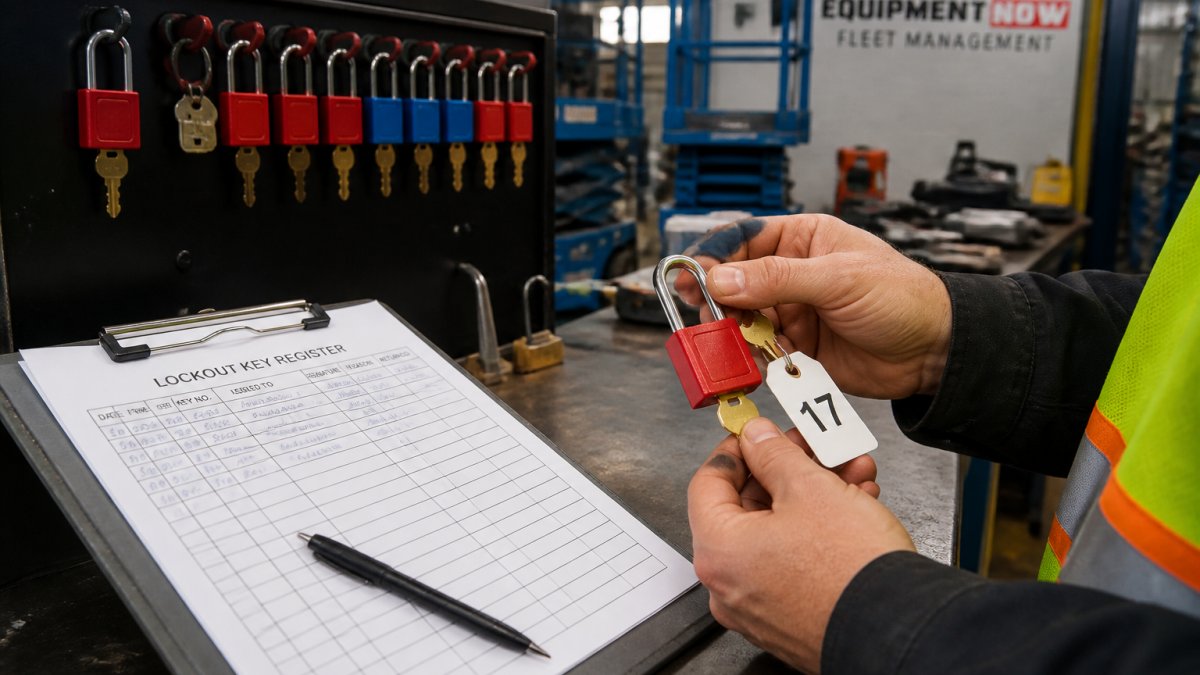
Issuing Keys and Recording Custody
Every authorized employee gets a personal lock and one key. No copies. No spares.
A common approach is a key register that captures:
- Key number and lock number
- Employee name and signature
- Date and time issued
- Equipment or isolation point
- Expected return date
Sequential numbering matters more than most guides admit. When locks and keys share a number, a missing key is easy to trace. A key register that lives in a binder nobody updates is worthless. Keep it where the locks are stored.
Return, Inspection, and Storage
Keys come back when the work ends, not when someone remembers.
- Inspect each lock for damage before it goes back in storage
- Confirm the key matches the lock number on the register
- Log the return with time and initials
- Store locks and keys in a locked cabinet, not a bucket
What most guides miss: the return step is where programs quietly fail. A key that never gets logged as returned looks identical to a key that was never issued.
Reconciliation: The Step That Closes the Loop
Reconciliation is the scheduled comparison of what the register says is out against what is actually in the cabinet. Without it, the register is a wish list.
A practical pattern is a daily or per-shift reconciliation at the lock storage point:
- Print or pull the open-issue list from the register
- Physically count the keys and locks in the cabinet
- Match each open issue to a worker, an equipment tag, or a documented removal
- Flag any key that is out past its expected return date
- Escalate unresolved items to the program coordinator before the next shift starts
Most practitioners find that a five-minute reconciliation at shift change catches more problems than a monthly audit. The reason is timing: a key that is missing at the end of a shift is still traceable to a person who is still on site. A key that is missing at the end of the month is a mystery.
Replacement and Re-issue
When a key is lost, damaged, or retired with its lock, the replacement has to be controlled, not improvised.
- Damaged key or lock: remove the lock using the documented removal procedure, retire the lock and key number, and issue a new numbered set to the same employee
- Lost key: treat the lock as compromised, replace the lock and key as a matched set, and record the old number as retired so it can never be reissued
- Retired equipment: close the lock and key numbers against the asset record so the history stays with the machine
A retired number that gets reissued is a traceability failure. Keep a retired-numbers list and check it before any new issue.
Why This Matters for Fleet Operations
For a fleet, the key register is not just a safety document. It is an asset-control document. When a machine is assigned to a worker, the lock and key numbers travel with that assignment. When the machine is serviced, the maintenance record references the same numbers.
That continuity is one of the quiet benefits of fleet management over a scattered ownership model. A managed fleet keeps the lockout record, the maintenance record, and the assignment record in one place.
Group Lockout Tagout Procedure: Key Custody for Crews
A group lockout tagout procedure assigns one key to a group lockbox, and every worker in the crew then applies their own personal lock to that box. The equipment stays locked until the last personal lock comes off.
Here is the sequence we recommend:
- The authorized employee isolates the energy source and applies the group lock
- The group key goes into the lockbox
- Each crew member applies a personal lock and keeps their own key
- Work proceeds
- Each worker removes their own lock when done
- The last person out retrieves the group key and restores the equipment
Shift handover is the hard part. The outgoing crew cannot simply hand a key to the incoming crew. Each worker removes their lock and the next shift applies theirs. That keeps custody clean and keeps accountability on one person per lock.
Lockout Tagout Lock Box Procedure: Centralizing Keys on Site
A lockout tagout lock box procedure keeps every group key in one controlled location on site. The box itself is locked, and only the designated coordinator holds the box key.
This is where digital inventory earns its keep. For a fleet or a multi-site contractor, digital key and lock inventory management lets you see which locks are out, who holds them, and when they are due back.
We group lock boxes into three types:
- Single-point box: one lock, one key, small jobs
- Group box: multiple personal locks on one hasp
- Trapped-key interlock: the key cannot be removed until the equipment is truly isolated
For contractors managing equipment across several properties, the group box is usually the right fit. It is simple and it scales.
Lockout Tagout Device Removal Procedure: Who Can Remove a Lock?
A lockout tagout device removal procedure exists to answer one question: who is allowed to take a lock off? The answer is the authorized employee who applied it, and no one else.
If that employee is unavailable, removal requires a documented process:
- Verify the employee is not on site
- Make every reasonable effort to contact them
- Have a second authorized employee inspect the equipment
- Document the removal in writing
- Notify the employee before they return to work
The one-lock, one-key principle is the backbone here. A single-key system means a lock cannot be opened by a supervisor with a master key or a duplicate. That is the point.
When Keys Go Missing: Lost, Stolen, or Damaged
A missing key is a live hazard, not a paperwork problem. Treat it that way.
- Lost: stop work at that isolation point, verify zero energy, and re-lock with a new lock and key
- Stolen: treat as lost plus a security review of the lock box and storage cabinet
- Damaged: remove the lock with the documented removal process and replace it
Log every event with the date, the lock number, the equipment, and the corrective action. Over time, those logs show you where your program is weak.
For fleet managers, this is where GPS tracking and equipment records help. When you know which machines are out and who is assigned to them, a missing key has a short list of suspects instead of a long one.
Auditing Key Control: Metrics, Inspections, and Reviews
A key control audit checks that every lock is accounted for, every key is signed in or out, and every removal was documented. Do it on a schedule, not when something goes wrong.
How Often to Audit
A workable cadence for most operations:
- Per shift: reconciliation of open issues against the cabinet
- Monthly: review of the register for gaps, overdue returns, and undocumented removals
- Quarterly: physical inventory of every lock and key, including retired numbers
- Annually: full review of the written procedure, training records, and corrective actions
Periodic inspection of the energy-control program is expected under the standard, and key control is a natural part of that review. If your register and your lock box disagree, you have a finding, not a rounding error.
Metrics Worth Tracking
Keep the list short enough that someone actually updates it:
- Locks issued versus locks returned
- Keys unaccounted for at end of shift
- Overdue returns as a percentage of open issues
- Documented removals versus undocumented removals
- Inspection findings closed on time
- Training completion for authorized employees
A rising overdue-return rate is usually the first sign that a program is drifting. It shows up before an incident does.
What a Finding Looks Like
A finding is any gap between what the procedure says and what the records show. Common examples:
- A key on the register with no matching lock in the cabinet
- A lock in the cabinet with no register entry
- A removal with no written authorization
- A retired number that reappears on an active lock
Each finding needs an owner, a corrective action, and a closure date. A finding that stays open for two audit cycles is a program failure, not a paperwork delay.
Connecting Key Control to Fleet Management
For a fleet, key control audits are more accurate when the lock records live inside the fleet management system rather than in a separate binder. The same platform that tracks equipment assignment, preventive maintenance, and GPS location can track lock and key numbers against each asset.
This is one of the practical benefits of fleet management over managing equipment as a collection of standalone assets. The audit trail is built in, not reconstructed after the fact.
Why Consignment Beats Auction at Retirement
When a machine leaves your fleet, the lockout record, the maintenance history, and the key history should leave with it.
For a fleet manager trying to close out a lockout record cleanly, consignment is the tidier exit. It preserves the audit trail, supports a higher realized value for a documented asset, and keeps the fleet's compliance story intact from acquisition through retirement.
Equipment Now Rental and Sales handles fleet management for contractors and municipal fleets, including equipment acquisition, preventive maintenance, GPS tracking, compliance, and asset retirement.
Frequently Asked Questions
What are the 7 steps of a lockout/tagout procedure?
The seven steps are: prepare for shutdown, notify affected employees, shut down equipment, isolate energy sources, apply lockout/tagout devices, release stored energy, and verify zero energy. Key control supports steps five through seven by ensuring only authorized employees hold keys to their personal locks. After verification, the equipment stays locked until the work is complete and the device removal procedure is followed.
Who keeps the key for lockout/tagout?
Each authorized employee keeps the key to their personal safety padlock. In group lockout situations, keys are placed in a group lockbox, and each worker applies their own lock to the box. Supervisors should not hold duplicate keys. This one-lock, one-key approach ensures no one can re-energize equipment while another worker is still exposed to hazardous energy.
What happens if an authorized employee loses a lockout key?
A lost key triggers an immediate response. The affected equipment stays locked until the key is found or the lock is removed through a documented removal procedure. The loss must be logged in the key register, and the lock may need to be cut off by a supervisor following a formal device removal procedure. Afterward, review the incident and update your key control procedure to prevent recurrence.
How often should a lockout/tagout program be reviewed?
OSHA requires a periodic inspection at least annually to verify that the energy control procedure is being followed. During this review, check key registers, lock inventories, and training records. If you find gaps, such as missing keys or unauthorized duplicates, correct them and retrain affected employees. More frequent reviews are wise after any incident or when equipment changes.