 blog
blog
Stump Removal Machine for Sale: What to Buy in 2026
Table of Contents
- Stump Removal Machine for Sale: Quick Comparison
- Commercial Stump Grinders: Specs That Decide the Purchase
- New and Used Inventory: What Changes and What Doesn't
- Stump Grinder Rental vs Purchase: Which Fits Your Workload
- Commercial Stump Grinder Price: What Drives the Number
- Stump Grinder Maintenance Tips for Longer Machine Life
- Safety Protocols and Size Selection Before You Buy
- Frequently Asked Questions
Last Updated: September 12, 2026
Stump Removal Machine for Sale: Quick Comparison
Shopping for a stump removal machine for sale comes down to matching three specs to your jobs: engine power, cutting depth, and how the machine reaches the stump. This guide from Equipment Now Rental and Sales breaks down what actually decides a purchase, so you can compare inventory listings with confidence instead of guesswork.
A stump grinder is a self-propelled or towable machine that removes tree stumps by rotating a carbide-toothed cutting wheel across the wood below grade (osha.gov). Commercial-grade units handle hardwood stumps, surface roots, and tight backyard gate access that consumer models cannot.
| Option | Typical Use | Key Trade-Off |
|---|---|---|
| Walk-behind grinder | Residential stumps, gate-limited yards | Lower horsepower, slower on hardwood |
| Tracked commercial grinder | Contractor crews, large removals | Higher cost, needs trailer and space |
| Towable grinder | Occasional rental or light ownership | Limited maneuverability on soft ground |
Below, we'll show you how engine displacement, track systems, and weight class separate a machine that pays for itself from one that sits idle.
Commercial Stump Grinders: Specs That Decide the Purchase
The specs that decide a commercial stump grinder purchase are horsepower, cutting depth, grinding wheel size, and track configuration. Everything else is secondary.
Horsepower and engine displacement determine how fast the grinding wheel chews through hardwood versus softwood. Cutting depth sets how far below grade the machine reaches, which matters for full root removal and replanting. Grinding wheel size and tooth count drive productivity: a larger wheel with more teeth replacement options cuts faster and stays sharp longer.
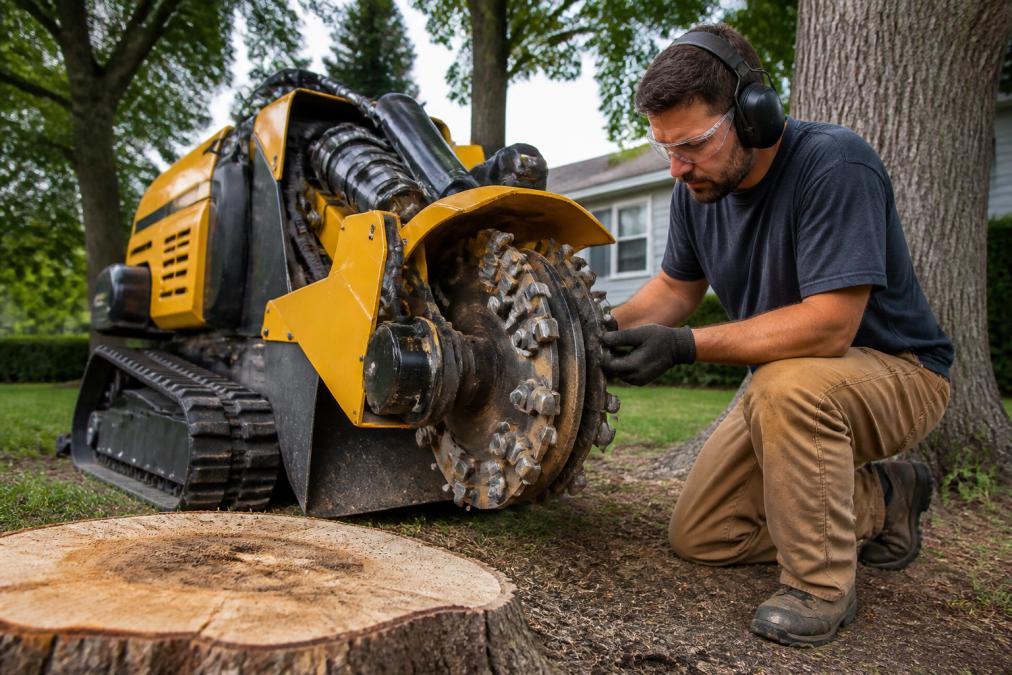
Track systems add cost but pay it back in maneuverability and ground clearance. A tracked machine walks over soft turf and slopes where a wheeled unit bogs down.
Engine Power, Cutting Depth, and Grinding Wheel Size
Engine power is the single biggest driver of grinding speed. Commercial units use larger displacement engines for sustained load, not peak output.
Cutting depth and grinding wheel size work together. A deeper cut removes more root mass in one pass. A larger wheel holds more teeth and clears chips faster. For professional contractors running daily removals, these three specs separate a machine that keeps crews moving from one that stalls on hardwood.
Track Systems, Ground Clearance, and Backyard Gate Access
Track systems decide where a machine can physically go. Backyard gate access is the constraint that kills more jobs than any other.
Measure your narrowest gate before buying. A tracked grinder with a narrow frame and good ground clearance fits through standard gates and climbs curbs. Wheeled units are cheaper but struggle on slopes and soft ground, and they need more room to turn.
New and Used Inventory: What Changes and What Doesn't
Used stump grinders hold their core value well. What changes is wear on the parts that do the work, not the machine's fundamental capability.
On a used unit, inspect the grinding wheel, teeth, hydraulic drive, and track or tire condition. These are the components that fail first and cost the most to replace. Engine hours tell you more than the model year. A low-hour machine with a worn wheel is a worse buy than a higher-hour unit with fresh teeth and a rebuilt hydraulic system.
New machines bring warranty coverage and current emissions compliance. Used machines bring lower entry cost and faster payback. Both are legitimate paths, and the right one depends on your workload and how much downtime you can absorb.
Stump Grinder Rental vs Purchase: Which Fits Your Workload
Stump grinder rental vs purchase is a workload question, not a budget question. Rent when stump removal is occasional. Buy when it is a recurring line of work.
Rental wins for homeowners with one or two stumps, for seasonal landscaping crews that only grind in spring and fall, and for contractors testing a machine before committing. Purchase wins when you grind weekly, when rental availability limits your scheduling, or when you need a specific size the rental fleet does not carry.
Equipment Now Rental and Sales offers online booking with real-time availability, so you can confirm a machine is reserved for your project before you commit a crew to it.
Commercial Stump Grinder Price: What Drives the Number
Commercial stump grinder price is driven by five variables you can actually evaluate before you call a dealer: engine displacement, cutting capacity (wheel diameter and swing arc), drive type (wheeled vs. tracked), condition and engine hours, and included attachments. Any quote that ignores your jobsite is guesswork, but the drivers themselves are predictable.
Here is how each one moves the number:
- Engine displacement. A larger-displacement engine (typically measured in cubic centimeters or liters) costs more up front but sustains load under continuous grinding. Smaller-displacement engines are cheaper to buy and cheaper to run, but they slow down on hardwood and force more passes.
- Cutting capacity. Grinding wheel diameter and the machine's swing arc determine the maximum stump diameter per setup. A wider arc means fewer repositioning moves, which is the single biggest productivity lever on a commercial job.
- Drive type. Tracked machines carry a premium over wheeled units because of the undercarriage, hydraulic drive motors, and added ground clearance. That premium buys access and slope capability, not raw cutting speed.
- Condition and hours. On used inventory, engine hours and component wear matter more than model year. A machine with fresh teeth, rebuilt hydraulics, and documented service history commands more than a low-hour unit with a worn wheel.
- Attachments and options. Remote control, autosweep, chip containment, and trailer packages all add to the delivered price. Decide which ones your jobs actually require before you compare listings.
New vs. Used Price Logic
New machines carry warranty coverage and current emissions compliance, which lowers your risk in the first year but raises your entry cost. Used machines lower entry cost and shorten payback, but you absorb the maintenance risk. The right choice depends on how many hours you will run per year and how much downtime your schedule can tolerate.
How to Frame the Payback Math
Rather than chasing a single price, frame the purchase against your workload:
- Estimate your annual grinding hours (jobs per month × average hours per job).
- Estimate your annual rental spend if you rented the same class of machine for those hours.
- Compare that annual rental figure against the purchase price plus estimated annual maintenance and fuel.
If rental spend approaches or exceeds the purchase price within a reasonable ownership window, ownership usually wins. If your hours are seasonal and sporadic, rental usually wins. Most contractors find the crossover happens when grinding becomes a weekly line of work rather than an occasional add-on.
For current pricing on new and used inventory listings, check Equipment Now Rental and Sales directly rather than relying on a generic range, but bring the five drivers above to the conversation so you can compare apples to apples.
Stump Grinder Maintenance Tips for Longer Machine Life
Most stump grinder for-sale pages stop at the spec sheet. Maintenance is where ownership cost actually lives, and it is the topic competitors skip. Here is a component-level guide to keeping a commercial grinder productive.
Cutting Wheel and Teeth
Teeth are the consumable that drives both productivity and fuel burn. Dull teeth force the engine to work harder, which raises fuel consumption and heat. Rotate or replace teeth on a schedule tied to engine hours, not to when cutting visibly slows, by the time you notice slowdown, you have already burned extra fuel and stressed the engine.
Inspect the wheel for cracks and the pockets for wear at every tooth change. A worn pocket lets a new tooth sit loose, which accelerates wear on the tooth and the wheel.
Hydraulic System
Hydraulic drive lines, fittings, and the reservoir are the second-most common failure point. Check fluid level and condition before each use, and inspect hoses for abrasion where they route near the frame or undercarriage. A slow leak that goes unnoticed can starve the drive motor and turn a cheap hose replacement into a pump or motor rebuild.
Replace hydraulic filters at the interval in your manual. Contaminated fluid is the leading cause of premature hydraulic component failure on grinding equipment.
Bearings, Pivots, and Grease Points
Grease bearings and pivot points at the intervals specified in your manual. The swing pivot and wheel bearings carry the highest load and are the most expensive to replace. A missed grease interval is the cheapest mistake to make and the most expensive to fix.
Engine Compartment and Cooling
Grinding throws chips, dust, and dirt. Clear the engine compartment, radiator, and cooling fins after every job. Restricted airflow causes overheating, and repeated overheating shortens engine life and can warp components (energy.gov). This is a five-minute task that prevents a multi-day repair.
Service Logging and Resale Value
Track engine hours and log every service, teeth, filters, fluid, grease, repairs. A documented service history is one of the strongest resale signals on used equipment, and it lets you spot patterns (for example, recurring hydraulic issues) before they become failures.
Common Failure Patterns to Watch
- Premature tooth wear usually points to incorrect tooth angle, worn pockets, or grinding in rocky soil.
- Hydraulic overheating usually points to low fluid, a clogged filter, or a failing cooler.
- Loss of cutting power usually points to dull teeth, a slipping belt, or low engine output, diagnose in that order.
A common mistake is running a machine until something breaks. Preventive maintenance is cheaper than a mid-job failure, and it is the difference between a machine that lasts and one that becomes a repair bill. For buyers weighing new and used inventory, Equipment Now Rental and Sales can walk you through specs, availability, and fleet options before you commit.
Safety Protocols and Size Selection Before You Buy
Safety protocols and size selection should be settled before you buy, not after. The right size is the smallest machine that handles your typical stump diameter, and the right safety setup is non-negotiable.
Wear eye protection, hearing protection, and steel-toe boots (osha.gov). Keep bystanders well clear of the discharge zone, and never grind with the wheel raised above the stump. Confirm the machine's weight class matches your trailer and tow vehicle.
For buyers weighing new and used inventory, Equipment Now Rental and Sales can walk you through specs, availability, and fleet options before you commit.
Frequently Asked Questions
How much does a stump removal machine cost?
Pricing for a stump removal machine depends on engine horsepower, cutting depth, track versus towable design, and whether the unit is new or used. Commercial-grade tracked grinders sit at the higher end, while smaller towable models cost less. Equipment Now Rental and Sales does not publish fixed figures because inventory shifts; check the website or request a quote for current pricing on specific units.
What is the best machine for removing tree stumps?
The best stump removal machine matches stump diameter, root spread, and site access. A self-propelled tracked grinder with a hydraulic drive handles large hardwood stumps and tight backyard gate access. For occasional smaller jobs, a towable grinder with a smaller cutting width works fine. Confirm engine displacement, grinding wheel size, and cutting depth before deciding.
What are the differences between tow-behind and self-propelled stump grinders?
Tow-behind grinders hitch to a truck or trailer and cost less, but you position them by hand, which limits maneuverability on soft ground. Self-propelled tracked models use a track system and hydraulic drive to move over lawns and through narrow gates without rutting. Tracked units carry more horsepower and cut deeper, which suits professional contractors running daily stump removal work.
Is it worth buying a stump grinder instead of renting?
It depends on job volume. Contractors grinding stumps most weeks recover the purchase cost faster than paying per-rental fees, and they avoid scheduling conflicts during peak season. Homeowners with one or two stumps usually come out ahead renting. Compare your annual stump removal jobs against rental rates, then factor in maintenance, teeth replacement, and storage.
Choosing the wrong stump removal machine for sale means paying for capability you never use or, worse, stalling on a job you bid to win. Equipment Now Rental and Sales helps you match engine power, track systems, and cutting capacity to your actual workload, with online booking, real-time availability, and fleet management that covers acquisition, maintenance, and asset retirement. Get started with Equipment Now Rental and Sales and put the right machine on your next stump removal job.