 ultimate-guide
Choosing the Right Lockout Padlocks and Tags in 2026
Table of Contents
- Why the Right Lockout Padlock Is a Safety Decision, Not a Supply Order
- OSHA 1910.147 Requirements: What Your Padlocks and Tags Must Meet
- Lock Body and Shackle Materials: Nylon, Aluminum, and Steel Compared
- Keyed-Alike vs Keyed-Different Lockout Locks: Which System Fits Your Crew?
- Lockout Padlock Color Coding Best Practices for Multi-Crew Sites
- Matching Tags to Padlocks: Durability, Weather, and Compatibility
- Key Control, Retirement, and LOTO Software Integration
- Conclusion
- Frequently Asked Questions
Last Updated: September 13, 2026
Why the Right Lockout Padlock Is a Safety Decision, Not a Supply Order
Choosing the right lockout padlocks and tags starts with understanding that these devices are the last line of defense between a worker and stored energy. A padlock that jams, a shackle that corrodes, or a tag that fades in sunlight can turn a routine maintenance task into a serious injury.
The stakes are concrete. Lockout/tagout remains one of the most frequently cited violations in general industry, and the devices themselves are the physical proof that energy isolation actually happened (osha.gov). This guide breaks down material selection, keying systems, color coding, tag compatibility, and the lifecycle questions most buyers never ask until it's too late.
OSHA 1910.147 Requirements: What Your Padlocks and Tags Must Meet
The standard is clear: each lockout device must be durable, standardized, substantial, and identifiable (Federal Register). Under OSHA 29 CFR 1910.147 energy control requirements, the lockout/tagout rule applies to servicing and maintenance of machines where unexpected energization could injure workers.
Lockout/tagout (LOTO) is the practice of isolating hazardous energy sources and securing them with locks and tags so equipment cannot be re-energized until work is complete. The regulation requires that lockout devices be:
- Durable: Able to withstand the environment where they're used
- Standardized: Consistent in color, shape, or size within a facility
- Substantially constructed: Not easily removed without excessive force
- Identifiable: Clearly showing the authorized employee responsible
Tags must warn against hazardous energy and remain legible. A tag alone is never a substitute for a lock when a lock is required.
Lock Body and Shackle Materials: Nylon, Aluminum, and Steel Compared
Material choice is really an environment question in disguise. The right answer depends less on the lock catalog and more on what the lock will be exposed to: washdown chemicals, salt air, sub-zero cold, abrasive grit, or a determined worker with a bolt cutter. Most ranking guides list the materials and stop.
Nylon-bodied locks are the workhorse for mixed-use and corrosive sites. The non-conductive body resists acids, caustics, and washdown chemicals, and it will not scratch painted equipment or create a spark. The trade-off is cut resistance: a nylon body is the easiest of the three to defeat with hand tools, so it belongs on energy points where physical attack is not the primary threat.
Aluminum-bodied locks handle temperature swings better than nylon and weigh less than steel, which matters when a worker is carrying a ring of locks up a ladder. Aluminum is softer than steel, so it dents and deforms under impact. It is a reasonable middle choice for indoor mechanical rooms and moderate outdoor exposure, but it is not the answer for high-corrosion chemical plants or high-security disconnect points.
Steel-bodied locks offer the highest resistance to cutting, prying, and impact. The catch is corrosion: bare steel rusts quickly in wet or chemical environments, so steel locks need plating, coating, or a stainless option to survive outdoors. Steel also sparks, which rules it out for electrical isolation work where a non-conductive shackle is required.
Shackle selection is where most buyers under-spec. Shackle clearance, the interior height of the shackle, determines how many locks and hasps can be grouped on one energy point during multi-crew work. A short shackle that fits one lock is useless when three crews need to isolate the same disconnect. Non-conductive shackles (nylon or plastic-coated) protect against incidental contact in electrical applications but carry lower tensile strength than steel. Longer steel shackles give you grouping capacity and cut resistance at the cost of weight and conductivity.
| Material | Best For | Key Drawback |
|---|---|---|
| Nylon body | Corrosive, wet, washdown, or mixed environments | Lowest cut resistance |
| Aluminum body | Temperature extremes, lighter carry weight | Dents and deforms under impact |
| Steel body | High physical-security needs | Corrodes without plating or coating |
| Non-conductive shackle | Electrical energy isolation | Lower tensile strength |
| Steel shackle | General industrial use, lock grouping | Can spark; needs coating outdoors |
Cold-weather and high-corrosion performance is the gap most guides skip. In sub-zero conditions, nylon and plastic components can become brittle, and moisture trapped in the shackle bore can freeze the lock closed. For freezer rooms, cold storage, and winter-exposed outdoor disconnects, look for locks rated for low-temperature service and keep the shackle bore dry and lightly lubricated with a cold-rated lubricant. In high-corrosion environments, chemical plants, food processing washdown areas, coastal or road-salt-exposed sites, stainless shackles and nylon or coated bodies outlast bare steel by a wide margin. A common pattern is specifying a corrosion-resistant lock for the whole facility rather than mixing materials, because mixed hardware can lead to standardization audit failures.
Keyed-Alike vs Keyed-Different Lockout Locks: Which System Fits Your Crew?
Keying systems decide who can remove whose lock, and getting this wrong undermines the entire program. Keyed-different locks each open with a unique key, so one authorized employee's lock cannot be removed by another. Keyed-alike locks share a common key, which suits a single department or a supervisor managing many points. Master-keyed systems allow both individual and supervisory access.
The trade-off is control versus convenience. Keyed-different offers the strongest protection against one worker removing another's lock, which is the exact scenario LOTO exists to prevent. Keyed-alike simplifies management but weakens that guarantee if a key is lost or shared. Most facilities use keyed-different for individual workers and reserve keyed-alike for departmental or group isolation.
Lockout Padlock Color Coding Best Practices for Multi-Crew Sites
Color coding turns a rack of identical locks into a visual map of who owns which energy point. The goal isn't decoration; it's instant visual identification during a walkdown or an audit.
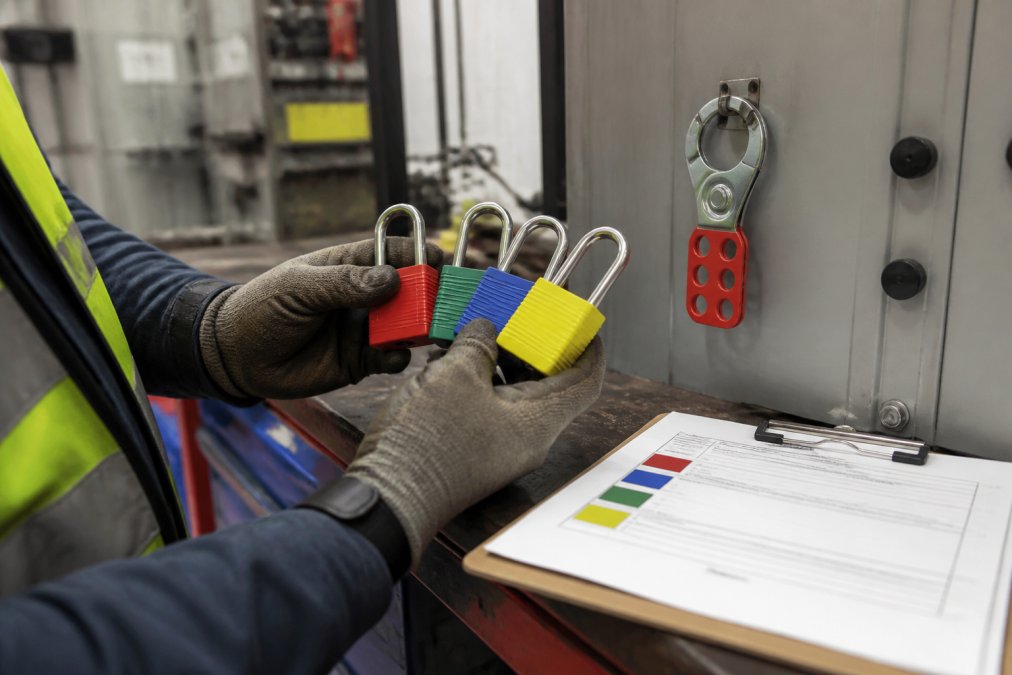
A workable scheme assigns one color per crew, trade, or department, then documents it in the written energy control procedure. Red often signals electrical work, blue mechanical, and green a specific subcontractor. The rule that matters most: pick a system, write it down, and enforce it consistently. Ad hoc color choices create confusion exactly when a worker is trying to confirm whether their lock is the only one on a disconnect.
Matching Tags to Padlocks: Durability, Weather, and Compatibility
Tags are the most neglected part of a LOTO kit, and they are the part most likely to fail an audit. A safety tag must identify the authorized employee who applied it, the date, and the reason for the lockout. Under the energy control standard, tags must warn against hazardous energy and remain legible for as long as they are in use. A tag that has faded to blank, torn off its grommet, or gone missing is a compliance gap even when the lock itself is still in place.
Tags take more abuse than the locks they accompany because they hang exposed, flap in wind, and get grabbed, snagged, and rained on. The durability question is therefore a materials question:
- Paper and cardstock tags are the cheapest and the shortest-lived. They tear at the grommet, bleed ink in moisture, and fade under UV within a season. They are acceptable only for short-duration, indoor, dry lockouts.
- Laminated or encapsulated tags seal the writing surface against moisture and UV. They cost more per tag but survive outdoor and washdown exposure, which makes them the practical default for any site with year-round outdoor energy points.
- Write-on reusable tags with a wipe-clean surface reduce waste and let crews re-label quickly, but the writing can smear if the surface is not fully dry before it is applied.
- Reinforced grommets matter more than most buyers realize. A tag is only as good as the hole it hangs from; a brass or stainless grommet outlasts a punched paper hole by a wide margin.
Compatibility is the second failure point. A tag that will not fit through the shackle or hasp gets left in the truck, and an unused tag is the same as no tag. Before standardizing, check two dimensions: shackle clearance (the interior height of the shackle) and grommet size relative to the shackle diameter. A tag with a small grommet will not slide over a thick steel shackle, and a tag with a large grommet will slip off a thin one. The fix is to specify tags and locks as a matched set rather than sourcing them independently.
Tag holders and pairing systems close the loop. A dedicated tag holder, a clip, pouch, or tether that keeps the tag attached to its lock, prevents the two from separating in a toolbox or on a rack. Some facilities go further and assign each lock a numbered tag so the pair can be tracked together. This is where physical LOTO hardware starts to connect with digital recordkeeping: a numbered lock-and-tag pair is far easier to log, audit, and reconcile than an anonymous lock with a loose tag.
Key Control, Retirement, and LOTO Software Integration
The parts of a LOTO program that fail aren't always the locks themselves; they can be the systems around them. Key management protocols, retirement schedules, and digital integration are areas where programs can encounter difficulties.
Key management should include a sign-out log, controlled master keys, and a documented process for lost keys. When a key disappears on a keyed-alike system, the affected locks come out of service immediately. Retirement follows the same logic: locks that show corrosion, damaged bodies, or worn shackles should be pulled and replaced rather than left in rotation. A lock that won't reliably open is a lock a worker will cut off, defeating the entire point.
Digital LOTO software is changing how facilities track this. These platforms log who applied which lock to which energy point, flag overdue lockouts, and generate audit trails. The locks still do the physical work, but the software closes the recordkeeping gap that paper logs never quite cover. That integration can contribute to a LOTO program that passes an audit and helps protect people.
Conclusion
The gap between a compliant LOTO program and a dangerous one usually comes down to details: the right material for the environment, a keying system that matches your crew structure, and a color and tag scheme everyone follows. Equipment Now Rental and Sales supports contractors and fleet managers with equipment acquisition, preventive maintenance, GPS tracking, compliance, cost analysis, and asset retirement through our Fleet Management Service, plus online booking with real-time availability for the machines your projects depend on. Get started with Equipment Now Rental and Sales and build a safer, better-managed operation from the ground up.
Frequently Asked Questions
Can you use standard padlocks for lockout tagout procedures?
Standard security padlocks do not meet OSHA 1910.147 requirements for lockout padlocks. A compliant lockout padlock must be durable, standardized, substantial, and identifiable, and it must be used only for lockout. Security padlocks are often too short in shackle length, not key-retaining, and may be opened without the assigned key. Using one for energy isolation exposes crews to hazardous energy and creates a citation risk during an inspection.
How do you choose between keyed-alike and keyed-different lockout padlocks?
Keyed-different locks give each authorized employee exclusive control of one padlock, which matches OSHA's expectation that each worker applies and removes their own lock. Keyed-alike locks let one key open multiple padlocks, which suits small crews, shared equipment, or contractors who need quick access across a site. Many safety programs use keyed-different locks for individual workers and keep a master-keyed set for supervisors and group lockout boxes.
What materials are best for lockout tags in harsh environments?
Look for tags made from laminated vinyl, polyester, or heavy cardstock with a write-on surface and a brass grommet. For outdoor work, cold storage, or wash-down areas, choose a tag rated for moisture, UV, and temperature swings. Tags should be legible, include the authorized employee's name and date, and attach with a non-reusable nylon tie or wire so they cannot be removed and reused after a shift.
What is the difference between a lockout padlock and a security padlock?
A lockout padlock is designed for energy isolation. It is non-conductive or spark-resistant, key-retaining, has a longer shackle for hasps and breaker handles, and is color coded for identification. A security padlock is built to deter theft, often with hardened shackles and short throws. OSHA 1910.147 requires lockout padlocks to be used exclusively for lockout, so mixing the two on the same job site invites confusion and compliance problems.