 how-to
How to Maintain Construction Equipment: 2026 Guide
Table of Contents
- Why Preventive Maintenance Matters More Than Repairs
- Daily Equipment Inspection Best Practices
- How to Maintain Construction Equipment: Fluids, Filters, and Lubrication
- Hydraulic Systems and Tire Health: The Two Biggest Failure Points
- Your Heavy Equipment Preventive Maintenance Checklist by Hours
- OSHA Equipment Inspection Requirements You Must Follow
- Using Construction Equipment Maintenance Software to Track It All
- Seasonal Downtime and Telematics: The Smart Maintenance Edge
- Frequently Asked Questions
Last Updated: September 9, 2026
Why Preventive Maintenance Matters More Than Repairs
Construction equipment is the most expensive asset on any job site, yet it is often treated as an afterthought until something breaks. Preventive maintenance is the practice of performing scheduled inspections, servicing, and part replacements before failures occur. A structured approach to upkeep extends equipment life and protects your bottom line.
The math is simple: an hour of scheduled maintenance costs a fraction of an hour of unexpected downtime. When a loader goes down mid-project, you are not just paying for the repair, you are paying for idle operators, missed deadlines, and the ripple effect on every other trade on site.
A common mistake is treating maintenance as a reaction to visible problems. By then, wear has already progressed, often damaging adjacent components. Routine servicing catches small issues while they are cheap to fix.
Daily Equipment Inspection Best Practices
The most effective maintenance program starts every morning with a walk-around inspection. Daily equipment inspection best practices focus on catching visible issues before the machine is put under load, and they take only ten to fifteen minutes per unit.
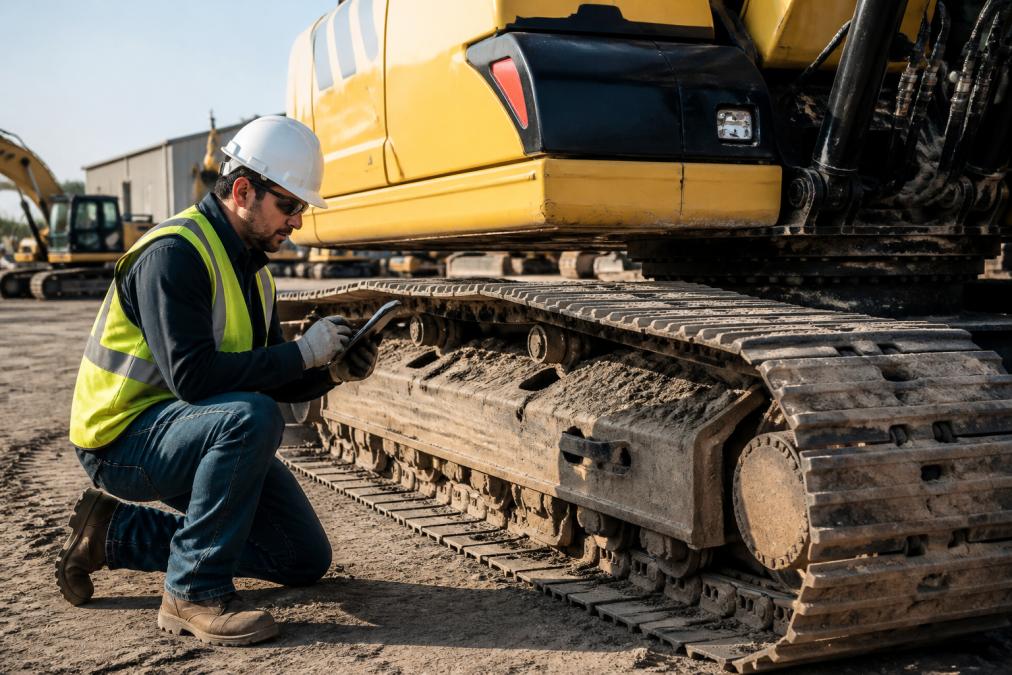
A thorough daily check follows a consistent sequence:
- Walk the full perimeter, looking for fluid leaks, cracks, or loose bolts.
- Check fluid levels: engine oil, coolant, hydraulic fluid, and fuel.
- Inspect tires for pressure and tread wear, or tracks for tension and damage.
- Verify all lights, horns, and backup alarms function properly.
- Look for debris buildup in radiators, filters, and undercarriages.
- Review the previous day's log for any noted issues or abnormal readings.
Operators should use a standardized checklist and report findings immediately. Assigning inspection responsibility to the operator who runs the machine builds accountability, since they are the first to feel and hear when something is wrong.
How to Maintain Construction Equipment: Fluids, Filters, and Lubrication
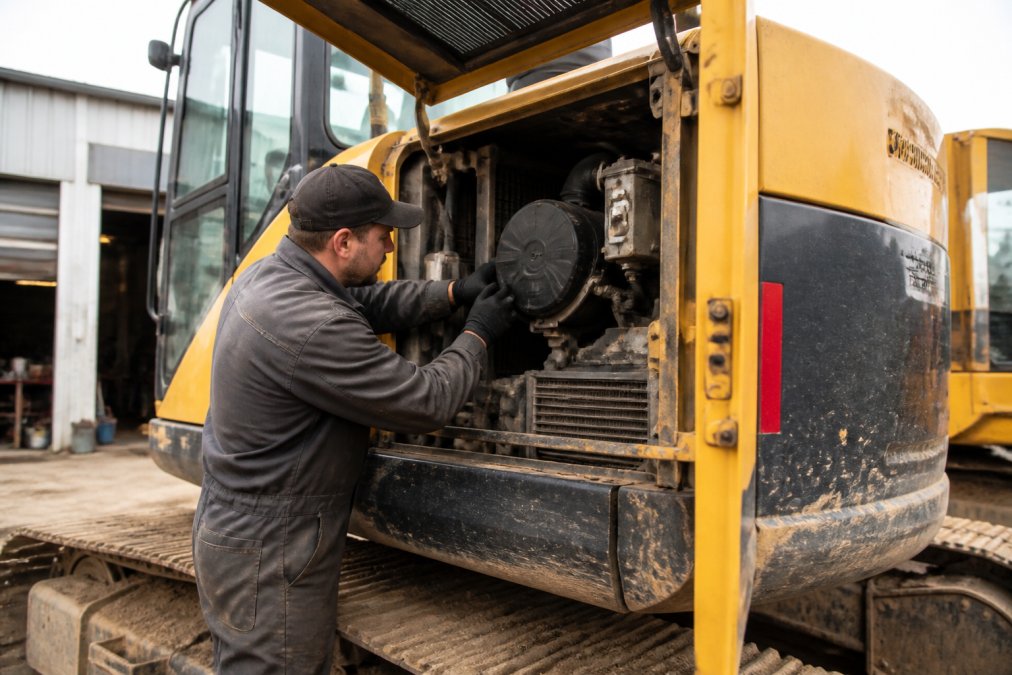
Fluids and filters are the lifeblood of heavy machinery, and managing them correctly is the core of any solid routine. Learning how to maintain construction equipment properly starts with understanding that clean oil and clean air are non-negotiable for engine longevity.
Fluid management goes beyond topping off levels. Contaminated fluid is a leading cause of premature wear. Oil analysis, where a sample is sent to a lab to check for metal particles and chemical breakdown, provides an early warning system for internal engine issues that visual inspections cannot detect.
Filter replacement should follow the manufacturer's intervals, not guesswork. Air, fuel, and hydraulic filters each have specific service lives under normal conditions. In dusty environments, air filters need more frequent attention, since a clogged filter restricts flow and reduces fuel efficiency.
Lubrication points, including pins, bushings, and pivot joints, are often overlooked because they require manual effort. Greasing these points drives out moisture and old grease while flushing out contaminants. Follow the equipment manual's lubrication chart for the correct grease type and fitting locations.
Hydraulic Systems and Tire Health: The Two Biggest Failure Points
Hydraulic systems and tires or tracks are responsible for the majority of unexpected field failures. Hydraulic systems operate under extreme pressure, often 2,000 to 5,000 psi on standard excavators and loaders, and the fluid must remain clean and at the correct level to prevent component damage (osha.gov).
Hydraulic System Maintenance: Diagnostics and Prevention
Hydraulic system maintenance requires attention to several areas. Check hoses and fittings for wear, chafing, or leaks, a pinhole leak under high pressure can spray atomized fluid that is both a fire hazard and a danger to skin. Monitor system temperatures, and ensure breather caps are clean so the system vents properly without drawing in dirt.
Beyond visual checks, a systematic diagnostic approach is essential. Check the hydraulic fluid level with the machine on level ground and cylinders fully retracted for the most accurate reading. Inspect the fluid's color and odor, a burnt smell or milky appearance indicates overheating or water contamination.
For recurring issues, use a flow meter and pressure gauge to test the system. Connect the gauge to the test port on the main pump and compare readings against manufacturer specifications. A pressure drop of more than 10% from spec often indicates a worn pump or failing relief valve. Check the return-line filter for metal particles, finding them indicates internal wear in pumps or motors.
A common pattern among fleet managers is to implement a three-stage hydraulic oil testing protocol:
- Visual inspection at every refill or top-off.
- Kick-out test monthly, run the hydraulic system to maximum pressure and listen for unusual noises or observe for sluggish cylinder movement.
- Laboratory oil analysis every 500 hours or at each scheduled oil change, checking for particle count, water content, and viscosity breakdown.
Tire and Track Health: Measurement and Management
Tire health is equally critical, especially for machines that travel between sites. Tire pressure should be checked cold and adjusted to the manufacturer's specification for the load being carried. Uneven tread wear signals alignment or inflation problems. For tracked machines, check track tension regularly, tracks that are too loose can derail, while overly tight tracks accelerate wear on sprockets and rollers.
For tires, use a calibrated gauge and check pressure daily for machines in continuous use. The correct pressure varies by load, refer to the tire manufacturer's load and inflation tables. Rotate tires according to the manufacturer's schedule and inspect sidewalls for cuts, bulges, or weather cracking.
For tracked machines, measure track sag as the primary tension indicator. Place a straight edge across the top of the track between the front and rear idlers, then measure the distance to the top of the track. Most manufacturers specify a sag of 1 to 2 inches for standard undercarriages. Adjust tension by adding or removing grease from the tensioner fitting, never by loosening the track adjuster lock nut while the machine is supported only by the track.
Track wear is measured by checking the height of the track grouser (the bar that digs into the ground). New tracks typically have grousers 1.5 to 2 inches tall; when height drops below 0.5 inches, traction degrades significantly and replacement should be planned. Check sprocket teeth for a hook-shaped wear pattern, which indicates the track is too tight.
A structured approach to these two systems will prevent the majority of unexpected downtime. Document every pressure reading, oil sample result, and track measurement in your maintenance log. Over time, this data reveals wear trends that allow you to predict component life and schedule replacements during planned downtime.
Your Heavy Equipment Preventive Maintenance Checklist by Hours
A heavy equipment preventive maintenance checklist organizes tasks by service meter hours, aligning maintenance with actual usage. This hour-based schedule ensures that wear items are serviced at the right time, regardless of calendar dates. The key is to use the manufacturer's intervals as a baseline, then adjust based on your specific operating conditions.
Standard Service Interval Framework
The table below represents a typical framework for mid-size excavators and wheel loaders. Always consult your specific model's operator manual for the definitive schedule.
| Service Interval | Key Tasks | Purpose |
|---|---|---|
| Daily (Pre-Start) | Fluid checks, walk-around, visual inspection, check for leaks | Catch immediate issues before operation |
| 100 Hours | Grease all fittings, inspect belts and hoses, check battery connections | Maintain lubrication and drive components |
| 250 Hours | Engine oil and filter change, check coolant level and concentration, inspect air filter | Protect engine internals from wear |
| 500 Hours | Hydraulic filter change, inspect tracks/tires, check swing bearing torque | Ensure system cleanliness and traction |
| 1000 Hours | Transmission service, full system inspection, replace fuel filter, check valve clearances | Address major wear components proactively |
| 2000 Hours | Major service: replace hydraulic oil, coolant, inspect pumps and motors, check cylinder seals | Comprehensive overhaul of wear items |
The 250-hour mark is often the most neglected interval. Operators remember oil changes but frequently skip the accompanying filter replacement to save a few dollars. This is a false economy, since running the filter past its service life releases trapped contaminants back into the engine.
Condition-Based Adjustments
Manufacturer manuals provide the definitive schedule for each model. Use those intervals as a baseline and adjust based on operating conditions, machines running in extreme dust, heat, or heavy load cycles should be serviced more frequently.
A common pattern among fleet managers is to apply a severity factor to standard intervals:
- Standard conditions (clean air, moderate temperatures, mixed duty cycle): Use manufacturer intervals as published.
- Dusty conditions (demolition, earthmoving, agricultural work): Reduce air filter service to 50% of the standard interval. Check the air filter restriction indicator daily.
- Severe duty (continuous operation, high ambient temperatures above 95°F, heavy loads): Reduce engine oil and filter intervals by 25% (e.g., from 250 hours to 190 hours).
- Cold weather operation (below 32°F): Use the manufacturer's cold-weather oil viscosity recommendations and consider more frequent battery checks.
Real-World Implementation Example
Consider a typical mid-size excavator working 2,000 hours per year in a mixed demolition and site-prep application. Under standard conditions, that machine would need:
- 8 engine oil and filter changes per year (at 250-hour intervals)
- 4 hydraulic filter changes per year (at 500-hour intervals)
- 2 transmission services per year (at 1,000-hour intervals)
- 1 major service annually (at the 2,000-hour mark)
In a dusty demolition environment, the air filter might need replacement every 250 hours instead of every 500 hours, adding 4 additional filter changes per year. That incremental cost is small compared to an engine rebuild caused by ingested dust.
The 1,000-Hour Inspection: A Deeper Look
The 1,000-hour service is the most critical scheduled maintenance event for most machines. Beyond the basic fluid and filter changes, this is when you should perform a comprehensive inspection of major systems:
- Undercarriage: Measure track sag, check sprocket and idler wear, inspect rollers for leaks.
- Swing bearing: Check for excessive play by watching for movement between the upper and lower structures when the machine is articulated.
- Cylinders: Inspect rod surfaces for scoring or chrome flaking, check for seal leaks at the gland.
- Cooling system: Pressure test the radiator cap, check for clogged fins, verify fan belt tension.
- Electrical system: Load-test the battery, check alternator output, inspect all wiring for chafing.
For rental equipment, the hour-based schedule is even more critical because machines may be used by multiple operators with varying skill levels. Rental fleets often use telematics to track actual engine hours remotely, ensuring service occurs precisely when needed.
OSHA Equipment Inspection Requirements You Must Follow
Beyond protecting your machinery, inspections are a legal obligation. OSHA equipment inspection requirements mandate that employers ensure construction equipment is examined before each use to identify any unsafe conditions. These standards apply to cranes, forklifts, and other heavy machinery used on construction sites.
OSHA requires that any equipment found to be unsafe during inspection be removed from service immediately until repairs are made. The OSHA standards for construction equipment safety detail specific inspection protocols and documentation duties for employers. Operators must also be trained and certified to run the equipment they are assigned, which ties operator competence directly to site safety.
Documentation is a critical part of compliance. Inspection records should be kept on file and made available upon request. A well-maintained log proves you have met your obligations and protects you in the event of an audit or incident.
Using Construction Equipment Maintenance Software to Track It All
Manual logs and spreadsheets become unmanageable once a fleet grows beyond a few machines. Construction equipment maintenance software centralizes scheduling, work orders, and history, automatically tracking service intervals and flagging when maintenance is due.
Modern fleet management platforms integrate telematics, which uses GPS and onboard sensors to monitor equipment health in real time. Telematics can alert you to fault codes, low fluid levels, and abnormal temperatures before they become visible problems, moving you from a fixed schedule to a condition-based approach.
For contractors managing multiple sites, a centralized system provides a clear picture of the entire fleet, which machines are due for service, which are operating efficiently, and which are approaching the end of their equipment life cycle. This data supports better decisions about repairs versus replacement.
The Federal Highway Administration guidance on asset management emphasizes that proactive maintenance strategies reduce lifecycle costs and improve operational readiness. A software platform operationalizes that principle by ensuring no service interval is missed and every repair is documented.
Seasonal Downtime and Telematics: The Smart Maintenance Edge
Equipment that sits idle during winter or wet seasons needs different care than equipment running daily. Maintenance during seasonal downtime focuses on preservation, ensuring the machine starts and operates reliably when the busy season returns.
Proper storage begins with a full service: change oil and filters, top off fluids, and grease all fittings. Fuel should be treated with a stabilizer and the tank filled to prevent condensation. Batteries should be disconnected and stored on a maintainer, and tires should be blocked off the ground to prevent flat spots.
Telematics provides the data edge that separates modern fleets from traditional ones. By monitoring battery voltage, fluid levels, and system pressures remotely, you can identify issues during storage rather than discovering them at the start of a project. Fleets that adopt these tools gain a significant reliability advantage over those relying solely on manual checks.
This guide is designed to help you protect your investment. When you rent from us, our fleet management service includes preventive maintenance, GPS tracking, and compliance so your project runs without equipment surprises.
Frequently Asked Questions
How often should heavy equipment be serviced?
Service intervals depend on the machine and the manufacturer's schedule, but the standard benchmark is every 250 hours for an oil and filter change. Daily fluid checks and greasing should happen every 10 hours or at the start of each shift. Follow the hour meter in your maintenance software rather than guessing by calendar date.
What is the difference between preventive and predictive maintenance?
Preventive maintenance follows a fixed schedule based on hours worked, like changing hydraulic fluid every 1,000 hours. Predictive maintenance uses data from sensors and telematics to spot wear before failure occurs, such as oil analysis showing metal particles. Preventive maintenance prevents most breakdowns; predictive maintenance catches the ones that slip through scheduled checks.
What are the OSHA equipment inspection requirements I need to know?
OSHA requires daily inspections of construction equipment before use, with documented results. For cranes, that means a shift inspection per 29 CFR 1926.1412. For other machinery like excavators and loaders, the rule is a visual check of critical parts, including brakes, steering, and safety devices. Keep written logs and correct any defect before the machine runs.
What is the 80/20 rule in maintenance?
The 80/20 rule in maintenance states that roughly 80 percent of equipment failures come from 20 percent of the possible causes. In practice, that means a handful of components, typically hydraulic hoses, filters, and tires, cause the majority of breakdowns. Focus your daily inspection checklist on those high-failure areas to get the greatest downtime reduction.
Keeping construction equipment running reliably is a constant challenge of scheduling, inspections, and documentation. Equipment Now Rental and Sales simplifies that burden with dependable rental equipment and full-service fleet management, including preventive maintenance, GPS tracking, and compliance support. Get started with Equipment Now Rental and Sales and keep your projects moving with machinery that is ready to work when you are.