 ultimate-guide
Benefits of Fleet Management Services for Construction
Table of Contents
- What Fleet Management Services Actually Do
- Reducing Fleet Operational Costs Through Smart Management
- Real-Time Visibility and Equipment Tracking
- Preventive Maintenance Schedules for Construction Equipment
- Benefits of Consigning Heavy Equipment vs. Auctions
- Compliance, Safety, and Risk Management
- Scaling Your Fleet Without the Headaches
- Frequently Asked Questions
Last Updated: September 20, 2026
What Fleet Management Services Actually Do
Fleet management services combine real-time tracking, preventive maintenance scheduling, compliance monitoring, and strategic asset lifecycle decisions into one coordinated system, delivering the benefits of fleet management through proactive equipment oversight. Instead of managing equipment reactively when problems occur, you manage it proactively before they happen. This shift from reactive to proactive is where the real benefits of fleet management services emerge, the difference between a profitable operation and one that bleeds money through downtime and emergency repairs.
Reducing Fleet Operational Costs Through Smart Management
The most immediate benefit of fleet management is cost reduction through three channels: fuel consumption, unexpected breakdowns, and idle time. A well-managed fleet addresses all three simultaneously.
Fuel Efficiency and Operating Costs
Real-time monitoring identifies excessive idling and poor maintenance that inflate fuel costs, while preventive maintenance schedules keep equipment running at peak efficiency rather than degrading until failure forces expensive emergency repairs.
Real-time monitoring identifies excessive idling and poor maintenance that inflate fuel costs, while preventive maintenance schedules keep equipment running at peak efficiency rather than degrading until failure forces expensive emergency repairs.
Idle Time and Asset Utilization
Idle time represents pure waste. Fleet management systems expose which assets are underutilized, enabling data-driven decisions to redeploy equipment to higher-value projects, consign them to another operation, or retire them from service.
Idle time represents pure waste. Fleet management systems expose which assets are underutilized, enabling data-driven decisions to redeploy equipment to higher-value projects, consign them to another operation, or retire them from service.
Preventive Maintenance vs. Emergency Repairs
A single hydraulic failure can result in significant emergency repairs and lost time. Preventive maintenance keeps equipment reliable, avoiding such costly incidents.
A preventive maintenance schedule reduces emergency incidents, saving on repair costs and avoiding project delays.
Calculating Your Potential ROI
Estimate ROI by calculating current fuel spend with efficiency improvement, emergency repair costs with reduction, and idle equipment days with reduction through better utilization or consignment.
Real-Time Visibility and Equipment Tracking
Real-time visibility into equipment location, use, and condition is the operational foundation for effective fleet management.
GPS tracking prevents the costly problem of losing track of assets across multiple job sites, eliminating confusion and delays from equipment being in the wrong place at the wrong time.
Telematics data captures engine diagnostics, fuel levels, operating hours, and maintenance alerts, showing trouble codes before catastrophic failures and triggering automated maintenance alerts before breakdowns occur.
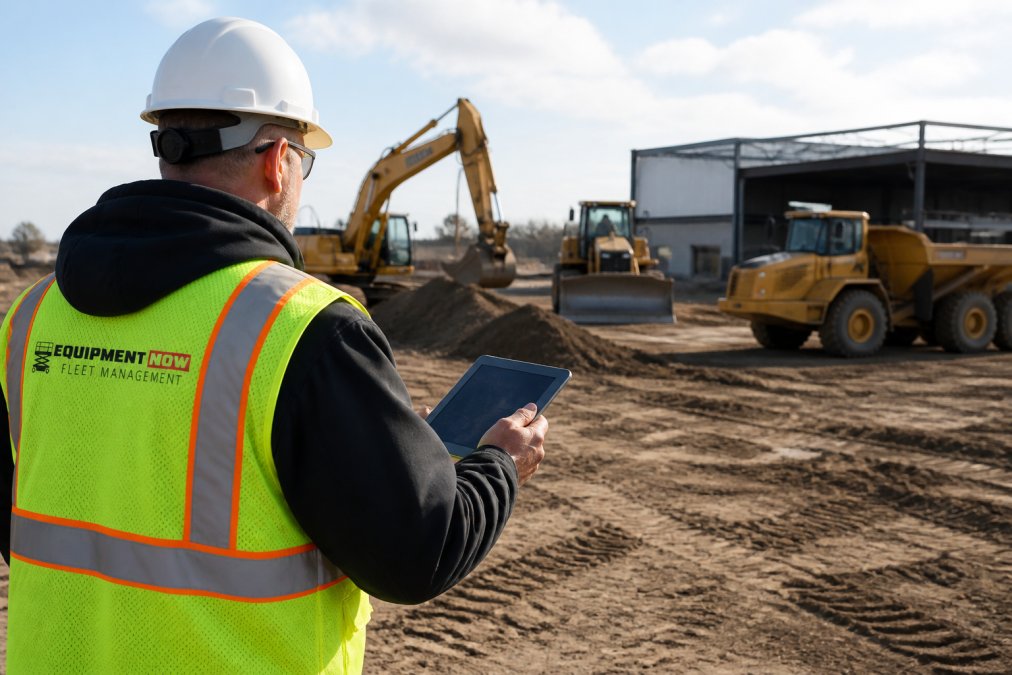
For contractors managing multiple projects, this visibility eliminates guesswork about asset availability, enabling faster job completion and fewer scheduling conflicts.
Real-time tracking systems automatically generate compliance documentation, turning regulatory reporting from a manual burden into an automatic byproduct of normal operations.
Preventive Maintenance Schedules for Construction Equipment
Preventive maintenance schedules transition fleet management from visibility to action, scheduling maintenance based on operating hours, time intervals, or condition-based triggers rather than waiting for failure.
Construction equipment operates in harsh environments where dust, mud, and heavy loads accelerate wear. Preventive maintenance schedules address wear before failure, extending equipment life significantly.
Scheduled maintenance happens during planned downtime, while emergency repairs occur when equipment is needed most. A single unexpected breakdown can delay entire project schedules, creating cascading problems.
Proper maintenance extends equipment lifespan significantly, maximizing value from each purchase or rental.
Equipment with documented preventive maintenance history commands better consignment and resale value, as buyers trust properly maintained equipment.
Benefits of Consigning Heavy Equipment vs. Auctions
When equipment reaches end-of-life or you need to reduce your fleet, consignment through a dealer network typically outperforms auction sales in both value recovered and effort required.
Consignment through established dealers offers several advantages over auction sales. First, consignment reaches a broader network of qualified buyers who are actively looking for that specific type of equipment. Consignment dealers have established relationships with contractors, rental companies, and businesses who need that equipment category.
Second, consignment eliminates the auction model's pressure to accept whatever bid comes in on auction day. With consignment, your equipment stays available until the right buyer appears at the right price. You're not forced to accept an undervalued bid just because the auction is happening. This flexibility typically results in better pricing, especially for specialized or newer equipment.
Third, consignment handles the logistics and inspection process. The dealer assesses condition, handles any minor repairs needed to make the equipment marketable, and manages the entire sales process. You're not coordinating with an auctioneer, paying auction fees, arranging transport to an auction location, or dealing with the uncertainty of auction day.
Auction sales do have one advantage: speed. If you need to move equipment quickly and don't care about maximizing value, an auction gets it done fast. But for most situations where you want fair market value and reasonable timing, consignment outperforms auctions. The dealer's incentive is to sell your equipment at the best possible price because their commission depends on it.
Compliance, Safety, and Risk Management
Heavy equipment operation exists within a regulatory framework. Electronic logging devices (ELDs), maintenance documentation, operator qualification records, and safety protocols all require management and documentation. But compliance alone doesn't drive adoption, the real challenge is getting operators and drivers to embrace the technology and behavior change that fleet management requires.
Regulatory Compliance and Documentation
Fleet management systems automate much of the compliance burden. ELD mandate compliance happens automatically when your equipment is properly tracked. Maintenance records are generated as part of normal operations, not compiled manually after the fact. Safety metrics like operator behavior scoring help you identify risky practices before they result in incidents.
Insurance companies increasingly offer better rates to operations that demonstrate strong safety and maintenance records. Fleet management data provides exactly that documentation. You can show that equipment is maintained on schedule, that operators are trained and monitored, and that you're actively managing risk. This translates into lower insurance premiums and potentially fewer claims.
The liability protection aspect shouldn't be overlooked. If an equipment failure causes an incident, documented preventive maintenance schedules demonstrate that you maintained the equipment properly. This documentation protects you legally and supports insurance claims. The alternative, no maintenance records and reactive repairs, leaves you vulnerable if something goes wrong.
The Driver and Operator Adoption Challenge
Where many fleet management implementations fail is in the human element. Operators and equipment drivers often view real-time tracking and behavior monitoring as invasive surveillance rather than a tool that protects them and improves operations. Without addressing this perception directly, adoption stalls, data quality suffers, and the promised benefits never materialize.
Successful implementations treat operator buy-in as a project phase, not an afterthought. This means:
Transparency about what is being tracked and why. Operators need to understand that the system monitors equipment condition and fuel efficiency, not just their location. Frame it as a tool that prevents breakdowns that strand them on a job site, not as a way to catch them taking breaks. Explain that behavior scoring identifies risky practices, excessive idling, hard braking, speeding, that damage equipment and create safety hazards. When operators understand the "why," resistance drops significantly.
Incentive alignment. Some operations tie safety bonuses or performance incentives to fleet management metrics. Operators who maintain excellent behavior scores, avoid unnecessary idling, and report maintenance issues proactively earn recognition or financial rewards. This transforms the system from a surveillance tool into a performance management system that benefits them.
Training and feedback loops. Operators need hands-on training on how to use the equipment in ways that minimize fuel consumption and wear. They need regular, non-punitive feedback on their performance scores. A monthly safety meeting reviewing fleet data trends, "Here's how our fuel efficiency improved this quarter", creates a sense of shared ownership rather than top-down enforcement.
Phased rollout. Implementing fleet management across an entire operation at once creates resistance and confusion.
Safety Metrics and Incident Prevention
Scaling Your Fleet Without the Headaches
As your operation grows, fleet management becomes exponentially more complex. More equipment means more maintenance to coordinate, more compliance documentation to track, and more decisions about what to keep, upgrade, or retire.
Frequently Asked Questions
What are the primary benefits of using professional fleet management services?
Professional fleet management services handle equipment acquisition, preventive maintenance, GPS tracking, regulatory compliance, and asset retirement, freeing your team to focus on projects. You gain real-time visibility into equipment location and condition, reduce unexpected downtime, lower fuel and maintenance costs, and ensure compliance with regulations like the ELD mandate. Most contractors see improved equipment uptime and clearer cost control within the first few months.
Why is consigning equipment through a fleet manager better than selling at public auctions?
Consignment through a fleet manager typically yields higher returns. You avoid auction fees, competitive bidding that drives prices down, and the uncertainty of auction timing. Fleet managers can match equipment to buyers who need exactly what you're selling, resulting in better prices and faster sales compared to traditional auction routes.
How does preventive maintenance reduce downtime and costs?
Preventive maintenance schedules catch issues before they cause equipment failure. Regular inspections, fluid changes, filter replacements, and component checks extend equipment life and prevent costly emergency repairs that halt projects. Fleet management services track maintenance history and automate scheduling, ensuring nothing is missed. This approach typically reduces unexpected breakdowns and extends vehicle lifecycle, lowering your total cost of ownership.
Can fleet management services handle equipment for multiple job sites or properties?
Yes. Fleet management services are designed to scale across multiple locations. GPS tracking and telematics give you real-time visibility of all equipment regardless of where jobs are happening. Automated alerts notify you of maintenance needs, idle time, or unauthorized use across your entire fleet. This centralized approach works for small crews managing 5-10 pieces of equipment or larger operations with dozens of assets across multiple properties.